This is a blog entry I forgot to publish, back from 2020. Enjoy!
I may be a latecomer to New Orleans, but it seems I’m making up for lost time.

Before my son Sasha chose Tulane, I’d never visited the city. I knew NOLA purely through the novel The Awakening and a vague sense of its great jazz. I had standard images that flickered across my lids: the filigreed second floor balconies, Creole and Cajun culture, Mardi Gras, which I glimpsed through the beads and feathered masks I found in my late mother-in-law’s drawers.
Then came our research for our book, Sugar Changed the World. Louisiana, New Orleans, is sugar. Louisiana was a slave state where the death rate exceeded the birth rate—because of sugar’s brutal conditions. New Orleans is where Norbert Rilleux, a free man of color, invented a more efficient crystallization process for sugar, on the plantation that is now Audubon Park. One cannot walk the streets of NOLA, especially Uptown, without realizing the gouging imprint of sugar and slavery–each of the main arteries that cut down to the winding Mississippi, streets like Louisiana, or Jefferson—were the boundary lines for the narrow plantations that fronted the river. At Tulane there was an old iron bell that the freshman touched for good luck—until it was revealed that this was the bell used to direct the slaves in the fields, and it was recently removed.  On one of my first evenings in NOLA, a neighbor at my Airbnb and a history aficionado, showed me his framed copy of the map that shows those plantations—thin, thin dominoes of land—and I was reminded of the narrow parcels of land that made up the plantations on the coastline of my father’s country, British Guiana. As my dad used to say, “Booker [the sugar company/conglomerate] owned us.” Sugar definitely owned a lot of folks in New Orleans, too.
To say that I have fallen in love with New Orleans is an understatement. Every time I go to visit, I start with a long list in my head of all I want to explore, and I leave with an even longer list for the next trip. I seem to tackle areas swath by swath, and always leave hungry for more. We stayed in the French quarter the time we dropped Sasha off (which I’ll never do again, given its touristy, drunken crowds) but we did buy some cool clothes at Rubinstein’s on Canal Street, one of the last of the Jewish department stores, where a Morehouse graduate treated my husband very well in his search for some finer summer threads. I then read up on the Jewish peddler community and learned that inter-marriage was accepted—Jewish men marrying local women–and so the early Jewish community was Creole in nature. Maybe as someone mixed race, mixed culture, that’s why this place is so irresistible to me—its DNA of mingling and blurring boundaries to make its own vibrant medley feels just right.

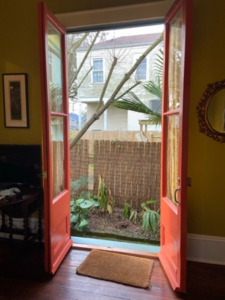
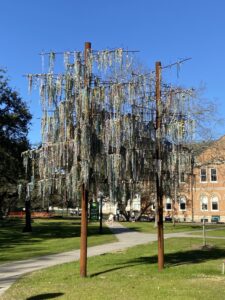
 On this visit, every day after writing in the high-ceilinged Uptown apartment, I walked miles and miles. The purpose of this trip, beyond seeing my son, whom I greatly miss, and doing a writing retreat, was to heal my back, which suffers during the cramped cold months of winter. I am at heart a warm weather girl, and NOLA offers the perfect soul and muscle therapy. I threaded through Uptown, the Garden District, the Irish Channel and Magazine Street, chatting with shop owners; I traipsed along St. Charles Avenue, listening to the metallic slide and clank of the street car; to Tulane, over and around in Freret (taking out my son’s roommates to a new hip taco place made out of a vintage gas station with picnic tables outside), around Audubon Park with its draping Spanish moss lit up in the sun like gray-green mantilla lace. That it was the Covid era was something of a boon: safety, a light sense of enjoyment in the outside, but none of the grunge and crowds.
 I’ll be honest: there are aspects of NOLA I haven’t fully warmed to. Undergraduate Tulane sometimes feels like the suburbs, transplanted, lots of well-off kids having a good time in their Uptown bubble. Nobody is too over-serious or anguished, it seems—nothing like my college life at Cornell, where we talked about Heidegger and the Holocaust and Virginia Woolf and gorged on foreign films every Friday night. I was hopelessly intellectual and intense. On Friday NOLA moved into Phase 2 and one could feel a palpable shift and loosening. There was a long car line, boys packed in trucks with their caps on backward, on their way to the Fly, the little hang out area where you can watch the sunset on the banks of the Mississippi.
Tulane is the whitest, most American community my son has ever belonged to, though he is also a creature of the suburbs who wanted that ‘standard’ college experience. He told me his way of navigating its whiteness is through hoops—basketball—the other activity he seems to be majoring in. His second home is the Tulane team, its athletic facility, and before Covid, Elevate, an organization that uses basketball to instill discipline and skills for at-risk youth. He walks the streets of NOLA telling me all kinds of details from his early New Orleans history class, or what he’s learned from the Latin American research librarian for his DIY history course, the aim of which is to create an historical exhibit. I guess something of the considerable Tulane academics is sticking. The kid wants to stay for a masters degree in history—and more basketball life. New Orleans is hard to leave, everyone says, and he has certainly succumbed.
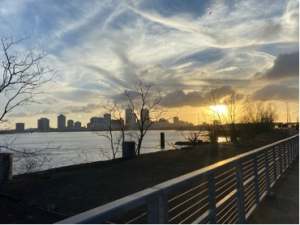 Yet to fall in love with this city is to also feel profound, heart-scraping sorrow. If you go a layer down in NOLA there is a lot to mourn. Yes, it is a city of the pleasure principle—the astonishing food, the extraordinary architecture, the music, the sense of pure celebration, improvisatory living and creativity. Even during Covid—I took a walk to Crescent Park, an urban park salvaged from the industrial edge of the neighborhood, and there were folks roller skating, picnicking and listening to a jazz group on the edge of a scruffy swath of grass as a freighter plowed up river.
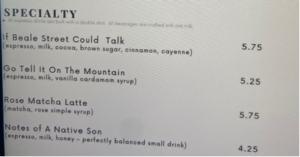 The newly opened Baldwin and Company, the first independent, black-owned bookstore was hopping on a Sunday, and a singer and her piano player regaled the coffee drinkers in the attached courtyard. The bookstore is an act of historical push-back: named, of course, after James Baldwin, whose father fled the racism of the city, with coffee drinks such as “If Beale Street Could Talk.” It stands not far from the site where Homer Plessy, a mixed-race man, intentionally violated the separate street car ruling, resulting in the terrible Plessy vs. Ferguson Supreme Court ruling. I spoke to the owner briefly, and he told me that his aim is to create a community space and bring back books and literacy to the community.
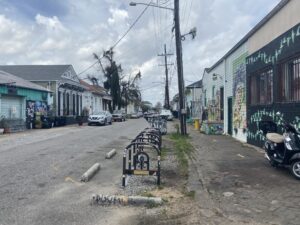 But there’s also a lot of emptiness and quiet in areas that used to be full of porch and street life and conversation; an awareness of the terrible scourge of Katrina; the people who did not come back or died in their water-swollen yards or up in their suffocating attics. On an earlier trip, Sasha and I biked around in search of a Second Line parade, and wound up stumbling into a party in Treme and were promptly invited in by the young couple, fed rice and beans, and told to enjoy the game that was on TV. Even beneath the most superficial conversations, one felt the pain of lost and recovered houses, family dispersed to Texas, Mississippi, Alabama. Opportunity, yet uncertainty. The buildings and hotels rising up downtown were built by undocumented labor, and if they complained about shoddy conditions, ICE deportations were a way of keeping it hush. Thus the collapse of the Hard Rock hotel, killing three, not too long ago.
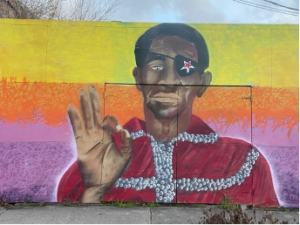 Bywater, a low-slung neighborhood of tightly packed shotgun houses, defined by St. Claude, an artery that goes straight out to East New Orleans and the bayou, is now hip, hip. The shotgun house next door to the cottage where I stayed, with its jumble of pipes and wood in the yard, is for sale for well over $400,000.
 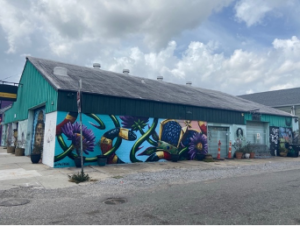 Amazing restaurants, a craft beer tavern, a food market, soaring industrial lofts. A food co-op, alternative burlesque venues, gorgeous murals, the New Orleans Center for Creative Arts. All of this is to be celebrated, of course—NOLA has risen, in many ways, from the devastation. But there is a fragility to its working-class black culture, which is endangered, fading beneath the freshly painted houses. Gentrification has swallowed whole neighborhoods as forcefully as the hurricane did. One fears that precisely what gives the city its essence will be felt as an absence, a kitschy plaque or souvenir.
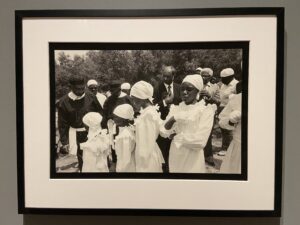 Thus I’m diving a few layers down to not just skim on NOLA’s Big Easy patina, and wanted to mention some discoveries: at the Ogden, a superb museum, I discovered the work of a collaborative photography couple, Keith Calhoun and Chandra McCormick, both from the 9th Ward. They’ve been on a decades-long journey, documenting black culture and also images of labor—sugar workers, dock workers, Angola, the nearby prison, which, for all intents and purposes, is a new form of slavery. Their interview here: https://antigravitymagazine.com/feature/labor-love-an-interview-with-keith-calhoun-chandra-mccormick/ This semester I’m teaching Sarah M. Broom’s memoir, The Yellow House, which gives such a full-on portrait of a sprawling, complicated family in East New Orleans.
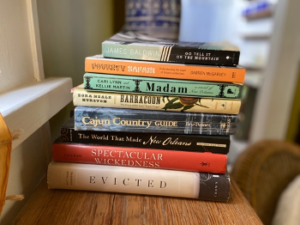 Both places where I stayed in NOLA were rich with books—the first because the landlady is a realtor and a voracious reader, friend of many authors. The second place, a Creole-inspired cottage down a narrow alley, had a haunting stack which contained Rebecca Solnit’s Unfathomable City: A New Orleans Atlas, with some fascinating essays. And since I’ve returned, like a lover experiencing withdrawal from her beloved, I am watching the HBO series Treme. While the writing can be clunky and expositional, the filmmaking around the city itself, the musicians, the devastation of Katrina, spins with incantatory power. Next up is the documentary Trouble the Water; Fatima Shaik’s just published Economy Hall: A Hidden History of a Free Black Brotherhood. A few years ago, I met a New Orleans writer, Tom Piazza, at the Virginia Center for the Creative Arts—he was always the one starting up the music in the little gazebo at night—and I’m curious about his books, especially Why New Orleans Matters. And finally, as I’m writing this, CNN just published an article on how climate change is speeding up gentrification in places such as Bywater and the Irish Channel, a neighborhood that went from 75% Black in 2000 to 71% White in 2019.
Some of these may be old news to y’all, but this is a start.
When you fall in love with a place, you close your eyes, and the beloved is all you see and hear.