The Website of Author & Editor Marina Budhos

Category: Photography

Private Coaching vs. The Creative Writing Workshop—Knowing vs. Doing

Since I’ve begun working a writing coach and developmental editor it’s been fascinating to ponder the differences between teaching creative writing in a structured academic classroom versus working with private clients.

When I prepare a creative writing curriculum or syllabus, I roll out a series of exercises, where students hone in on a particular aspect of craft—be it point of view, or dialogue, or three-dimensional characters.  The beauty of this method is the lack of commitment.  The very fact that students can dash something off, without pressure, is a sneaky way to learn craft and also warm up their writing muscles.  These exercises are sketches, no different than what one might do in a drawing class, in preparation for a more elaborate canvas. Very often those small, inobtrusive exercises develop and grow into longer works that the students developed later on in the semester.  Over the years I’ve had many students whose story collections, novels, and essays germinated from these brief sketches.

But there can be a downside to this way of teaching.  Oftentimes, what students learn in the exercises doesn’t metabolize into the longer manuscript.  That is, students may master a particular aspect to fiction writing in their short piece—say, heightened emotion through indirect, significant details—but when they are setting down their scenes with the manuscript they’ve committed to, none of what they’ve learned is on display.  These craft lessons simply don’t carry over.

My colleagues in Rhet Comp used to speak of a phenomenon called “knowledge transfer” –apparently this is a whole field of research. Writing skills that are taught, say, in a freshman comp course don’t necessarily carry over into the next subject course where writing is required.  For instance, one can teach how to write a topic sentence in an argumentative essay, but when asked to write one for their history course, they don’t ‘transfer’ the skill or knowledge for their history paper.  It’s as if they’re starting all over again.

Now I don’t mean to shoehorn the associative, mysterious, creative alchemy of fiction and creative nonfiction into an academic, skills-based regimen.  But I do think that the exercise-based way of teaching craft does mean that isolated craft lessons can remain a bit abstract for a fledgling writer. Those short sprints don’t fully sink in.  They may understand an element of writing as a concept, but they don’t know how to activate it in a longer work.  I believe this has something to do with knowing versus doing.

What the private coaching environment allows me to do is show these same lessons organically—they emerge out of the manuscript in which the writer is already invested. Their invented world, their remembered experiences, are already alive and vivid in their minds.  So the teaching and learning process becomes very different. Our sessions become a kind of ‘real time’ lesson, a Deweyite ‘learning by doing’—a bit different than the exercises I would assign in an academic creative writing workshop.  A client will send me pages of a work-in-progress and I wind up creating a lesson on the spot—sometimes several lessons, since many elements of craft are embedded within the draft.

For clients who have taken many writing workshops or read a lot of craft books, these sessions then function as a kind of ‘Aha’ moment.  Yes, they’d heard about the concept of subtext in dialogue, but it isn’t until we drill down on the exchanges of characters they care about, that this starts to make sense. Yes, they’ve read about ‘significant detail’ but it isn’t until they are noticing how they haven’t activated all the juicy, telling bits of a world that is so clear to them, that the concept starts to click.  The beauty of this model is their engagement—they absorb these lessons more because we are discussing a story, a set of characters, a world, that they are already deeply invested in.

Now there’s one caveat: the difference between undergraduate and graduate, young adults and adults.  The exercise model that I designed worked very well for undergraduates, as they are learning to stand on shaky legs, like new foals starting to walk.  Yes, the same issues crop up—once they begin writing full on stories we lose some of the elements we’d focused on earlier.  But the method is worth it because these students are gaining in confidence to write more than a one or two-page exercise—they are starting to stride into the full-on arc of a narrative.  I find my young writers especially need prompts and short inspirational assignments, as they are daunted by continuing with a longer manuscript.  Short prompts, some of them done sequentially are the sneaky way of getting them to start building a full short story.

However, graduate students and coaching clients are adults, who often come with a burning fire for what they want to do or say. Maybe they’ve drafted a novel manuscript but stalled out,;or they’ve conceived of a series of short stories that are linked; or have a memoir about a particularly harrowing experience.  I find, then, that I’m teaching and editing all at once—helping them wrestle down their ideas, while also showing them the micro elements of craft that they don’t yet possess.  They are horses that have been running instinctively, often powerfully, but they don’t quite know how to move and pace themselves forward.

Thus, my own practice as a writing coach/developmental editor is a blend of teaching and editing.  My interest, as an editor, is to not only diagnose, as a good editor does, but to show the how of craft, as any good teacher does.

Any thoughts from those who have taken workshops versus worked one-on-one with a coach or developmental editor?

NOLA: A Love Letter

This is a blog entry I forgot to publish, back from 2020.  Enjoy!

I may be a latecomer to New Orleans, but it seems I’m making up for lost time.

Before my son Sasha chose Tulane, I’d never visited the city. I knew NOLA purely through the novel The Awakening and a vague sense of its great jazz. I had standard images that flickered across my lids: the filigreed second floor balconies, Creole and Cajun culture, Mardi Gras, which I glimpsed through the beads and feathered masks I found in my late mother-in-law’s drawers.

Then came our research for our book, Sugar Changed the World.  Louisiana, New Orleans, is sugar. Louisiana was a slave state where the death rate exceeded the birth rate—because of sugar’s brutal conditions.  New Orleans is where Norbert Rilleux, a free man of color, invented a more efficient crystallization process for sugar, on the plantation that is now Audubon Park. One cannot walk the streets of NOLA, especially Uptown, without realizing the gouging imprint of sugar and slavery–each of the main arteries that cut down to the winding Mississippi, streets like Louisiana, or Jefferson—were the boundary lines for the narrow plantations that fronted the river.  At Tulane there was an old iron bell that the freshman touched for good luck—until it was revealed that this was the bell used to direct the slaves in the fields, and it was recently removed.  On one of my first evenings in NOLA, a neighbor at my Airbnb and a history aficionado, showed me his framed copy of the map that shows those plantations—thin, thin dominoes of land—and I was reminded of the narrow parcels of land that made up the plantations on the coastline of my father’s country, British Guiana.  As my dad used to say, “Booker [the sugar company/conglomerate] owned us.”  Sugar definitely owned a lot of folks in New Orleans, too.

To say that I have fallen in love with New Orleans is an understatement.  Every time I go to visit, I start with a long list in my head of all I want to explore, and I leave with an even longer list for the next trip.  I seem to tackle areas swath by swath, and always leave hungry for more.  We stayed in the French quarter the time we dropped Sasha off (which I’ll never do again, given its touristy, drunken crowds) but we did buy some cool clothes at Rubinstein’s on Canal Street, one of the last of the Jewish department stores, where a Morehouse graduate treated my husband very well in his search for some finer summer threads. I then read up on the Jewish peddler community and learned that inter-marriage was accepted—Jewish men marrying local women–and so the early Jewish community was Creole in nature.  Maybe as someone mixed race, mixed culture, that’s why this place is so irresistible to me—its DNA of mingling and blurring boundaries to make its own vibrant medley feels just right.

On this visit, every day after writing in the high-ceilinged Uptown apartment, I walked miles and miles.  The purpose of this trip, beyond seeing my son, whom I greatly miss, and doing a writing retreat, was to heal my back, which suffers during the cramped cold months of winter.  I am at heart a warm weather girl, and NOLA offers the perfect soul and muscle therapy.  I threaded through Uptown, the Garden District, the Irish Channel and Magazine Street, chatting with shop owners; I traipsed along St. Charles Avenue, listening to the metallic slide and clank of the street car; to Tulane, over and around in Freret (taking out my son’s roommates to a new hip taco place made out of a vintage gas station with picnic tables outside), around Audubon Park with its draping Spanish moss lit up in the sun like gray-green mantilla lace.  That it was the Covid era was something of a boon: safety, a light sense of enjoyment in the outside, but none of the grunge and crowds. Continue reading

Henri Cartier-Bresson & India

2017 marks the 70th anniversary of the Magnum Photo Agency, founded by photography greats Robert Capa, Henri Cartier Bresson, David Seymour, George Rodger, William Vandervirt, and others right after World War II. Legend has it that Magnum was named after the magnum of champagne they drank to celebrate the agency, but with Capa one’s never sure. At the time, the photographers ‘divided’ up the world–Capa was somewhat ‘at large’ and Cartier-Bresson took Asia. The result is on display at the Rubin Museum in a rich show of his images of India at some truly key historic moments. Capa always told Cartier Bresson: “Stop calling yourself an artist. Say you’re a photojournalist.”

Surely these images reflect both: A fusion of exquisite sensitivity and composition, coupled with his keen sense of the historical moment: Henri Cartier-Bresson: India in Full Frame.


DACA, Dreamers

April 26, 2017

Two items caught my attention today: an undocumented Rutgers student, a Dreamer, asked by ICE to interview at their office and report about how much young undocumented immigrants contribute to the NJ economy–$66 million and it is estimated that they could contribute another $27 million if they could get on with their lives, continue to study and work.

DACA Student at Rutgers Interviewed by ICE Officials.

Report: NJ young immigrants pay $66 million in taxes

I actually believe many people are squeamish about defending undocumented immigrants.  It makes them uncomfortable.  Aren’t they criminals? Didn’t they break the law? Many Americans, in fact, may be uneasy with Trump’s demonization of immigrants, but might have trouble openly marching on their behalf.  Might they secretly wonder: It is too much, isn’t it? Could some of what he says be true? Are they ruining our economy? Taking over our cities, our towns? Aren’t they a drag on our resources?

I say this not because I believe these ideas, but because I believe we must bring out of hiding these shadow thoughts in ourselves.  And the only way to do so is to bring the cold, clear nuggets of facts, such as the ones above.  To hear these stories.  These are young people whom we have already invested in; young people who are already contributed; and who have so much more to offer.  Are we willing to lose that gorgeous hope and possibility?  Because of we shut ourselves to what they can be, we shut down what we can be as a nation.  I believe we are more capacious than this; that our republic, so different than others, has room and room again.  Let us not give into the shadows and fears; let us find a way.


On Re-reading Baldwin’s “Notes of a Native Son”

April 13th, 2017:

Last night I taught Baldwin (which the students loved) and the last lines kept resonating as I drove home: “It began to seem that one would have to hold in the mind forever two ideas which seemed to be in opposition. The first idea was acceptance, the acceptance, totally without rancor, of life as it is, and men as they are:in the light of this idea, it goes without saying that injustice is commonplace. But this did not mean that one could be complacent, for the second idea was of equal power: that one must never in one’s own life, accept these injustices as commonplace but must fight them with all one’s strength.”

And yet I must confess, that the phrase ‘without rancor’–which is so hard to do–might be also substituted ‘without grief.’ For even as I gained so much strength from Baldwin, I found myself suddenly crying at the latest headline regarding the withholding of Federal funds from Planned Parenthood. The outright cruelty of this move undid me. I was subsumed in grief–for the women whose lives will be affected, poor women, sick women, confused women, determined women. It was a stab to my gut, my own body, a shock.

I only hope in daylight I can muster up the two opposing ideas that Baldwin conjures up for us, his complex light through the tunnel, to see our way into the future.  But right now, my heart heavy, and it requires so much strength to rally forth.

Normality Elusive In Fraught Times–Muslim Teenagers after Orlando

An article in the NY Times today about how the Orlando killings are again snatching away a sense of normality for Muslim teens during Ramadan, a time that should be reflective and celebratory.

Last year, during Ramadan, I spent a lot of time wandering the streets of Queens and Brooklyn for my new novel Watched.  And what I was so struck by–and what is lost in these polarizing times where Islam is equated with frightening headlines–is the way in which Islam, observance, is part of the fabric of life, a rhythm for one’s days.  I watched families hurry to pick up last groceries, stroll and linger on streets before and after prayers,  crowd around tables under the pale wash of florescent restaurant light for the Iftar, the evening meal.  Little children cupped in father’s arms; a man and his wife, their robes blazing white in the dark, rushed off a bus, across a busy avenue.  By one tiny mosque, where the women prayed, jammed next to one another in a narrow basement, prayers voiced in through speakers, little children set off tiny bang-snaps outside, annoying the adults who also forgave them.  It was such a New York, a Brooklyn scene: how many children have been doing that for generations on borough pavements?

Take a look at the beautiful slide show that captures some of this.

First Stop: Barcelona

On August 5th, 2012, Marc, myself and our two boys, Sasha and Rafi flew to Barcelona—exactly 76 years after Capa and Taro when arrived to begin their photo-journey into the Spanish Civil War. Within a few months, Capa would become a world-famous war journalist. Both would reinvent modern photojournalism as we know it today. And in less than a year, the daring Taro would be dead.

We spent nearly three weeks in Spain, tracking, as best we could, some of the key sites and in some cases, visiting some of the exact locales where they shot photographs. Our last research day was in Brunete, where Taro was sideswiped by a swerving tank, and ultimately died in a hospital 30 kilometers away.

In this blog, I’ll be filling you in on our travels, our journey into the story of Capa, Taro, and Chim as we developed this book. Enjoy!

*****

Barcelona, August, 2012: This is the Barcelona I remember from 1983-84 when I backpacked through–and it isn’t. Still the same frilly-edged art nouveau buildings rising off the grand avenues; still the winding streets in the old quarter; and still good Serrano ham and manchego cheese to be found at all hours.

Yet there is a difference. Gone are the old women washing on the balconies, the clamoring parakeets and teeming plants; gone are the old men and women on Las Ramblas benches, the smokey-eyed gypsy children; the seedy, red light district, the dark mouths of nightclubs, where you walked downstairs and were never quite sure what you would find; gone is the morning wake up when we stayed in the old quarter—a bakery where fat-armed women shoved aluminum trays of quivering flan; the men in their slightly ill-made suits and hair wet down; the shoes thicker, sturdier; so much less polish and high-strung tourist sheen as I had encountered in Florence and Sienna. I could feel, in this city, the sense of the peasant, of the rustic.

At that time—28 years ago—my friend and I were at the edge of their lives, observing. Now it is throngs of tourists driving down Las Ramblas who are the center of the action; now they are flanked by shiny stores, tapas places that seem like remakes of the dark wood dives I drank in and ate before. When we reach Placa de la Catalyuna, I feel as if I’m in Times Square. We’ve stopped off at the official FC Barcelona store, where Sasha understands that I am not spending 100 dollars on a Messie shirt.

But we are here for history, and so we oblige, with Alan Warren, our chipper and cheerful guide who is obsessed with Spanish Civil history, knows it down to his bones, and leads tours throughout the region recreating Orwell’s steps, battles, particular regiments.

He has arrived at our large, atmospheric (and slightly odd) Eixample flat in his floppy khaki hat, his folder of images and notes, and marches us past the elegant art nouveau buildings, shows us the Hotel Majestic, which at the time was taken over by the Republican forces, and where long tables of food were served for free. Now it is swathed in scaffolding; I peek through the revolving doors to see the lobby is completely renovated—sleek marble, barely adorned—and intimidatingly pricey in look.

Another doorway is where deserters from the Nationalist side straggled in, along with recruits from abroad. This is the international surge that brought Capa and Taro to Spain in the early days, along with George Orwell, who would immortalize his time in the classic Homage to Catalonia:

“When the fighting broke out on the 18 July it is probable that every anti-Fascist in Europe felt a thrill of hope. For here at last, apparently, was democracy standing up to Fascism.”

Most certainly this is what Capa and Taro felt, back in Paris. Both were refugees from Hungary and Germany respectively; both were Jews who had begun to see the iron hand of anti-Semitism start to choke the political life of their countries. Indeed Capa had already had his run-ins for political activism, as did Taro, which is how they wound up in Paris, mingling among the many artists and emigres who had flocked to the city at this time.

Capa and Taro were also opportunists—in the best sense of the word. They sensed a chance, an opportunity, to make their mark through the growing field of photo journalism. They had met when Taro worked for Maria Eisner, who ran a photo agency, Alliance Photo. Taro helped to groom the scruffy Hungarian so he might better sell his work. Then she too took up the camera. It was only a matter of time before they felt the siren call to Barcelona, to Spain, where already, international volunteers were pouring in to fight Franco.

The Barcelona they would have encountered would have been similar to the city George Orwell described:

“… when one came straight from England the aspect of Barcelona was something startling and overwhelming. It was the first time that I had ever been in a town where the working class was in the saddle. Practically every building of any size had been seized by the workers and was draped with red flags or with the red and black flag of the Anarchists; every wall was scrawled with the hammer and sickle and with the initials of the revolutionary parties; almost every church had been gutted and its images burnt.”

“The revolutionary posters were everywhere, flaming from the walls in clean reds and blues that made the few remaining advertisements look like daubs of mud. Down the Ramblas, the wide central artery of the town were crowds of people streamed constantly to and fro, the loud-speakers were bellowing revolutionary songs all day and far into the night.”

“There was much in it that I did not understand, in some ways I did not even like it, but I recognized it immediately as a state of affairs worth fighting for.”

Certainly, Taro’s photographs during this time capture the revolutionary fervor, the joyous and ordinary ways that residents had taken up arms and were remaking their very city, their society. Taro shot children happily scampering on sandbagged walls, donning anarchist caps like any children playing made-up war games.

She followed Republican militiawomen training on the beach near the city—one of her most iconic a silhouetted woman, crouched, aiming her pistol—a symbol of equality promised women during this halcyon period, a time, as Orwell noted, when people did not address anyone as “Senor or Dona” or even use the formal “Usted.”

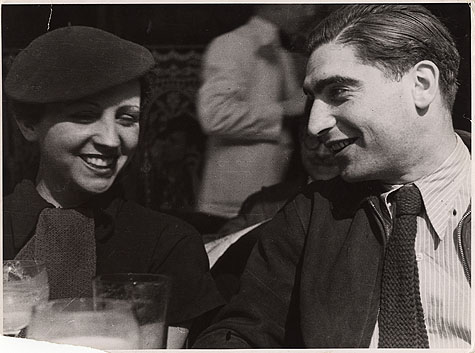
My favorites of Taro’s during this period are those of people laughing, relaxing in the August sunshine (Catalonia is indeed hot during those months). In one, a man and a woman lean back in two wicker chairs, heads tilted to one another, exchanging laughter; he casually holds a rifle between them. There’s an easy grace to the photo, men and women as comfortable compadres, as Taro and Capa were themselves.

In August 1936, when Taro and Capa and Orwell arrived in Spain, to join what they saw as the greatest struggle of their generation, they did not yet detect its dangerous and self-destructive undertow, nor did anyone anticipate the terrible destruction that would be unleashed with ariel bombing. (Indeed Barcelona was used as a testing ground for this new technology and the brutal air raids gave way to something called the “Barcelona Effect”—the more a civilian population was bombed, the more they in fact resisted) We pause at the reconstructed Coliseum, which now has a stark black steel memorial in front to memorialize those killed in the dreadful pounding that pummeled these grand streets.

“There was much in it that I did not understand, in some ways I did not even like it, but I recognized it immediately as a state of affairs worth fighting for.”

Yet if anything characterizes the Spanish Civil War, it was the deadly factionalism that would eventually splinter the Left, particularly as the Soviets played a deadly game of suppressing the Anarchists and undermining their hold on the local population.

Less than a year after that optimistic period that Capa and Taro recorded visually, a stand-off between the Communists and Anarchists was taking place: “The word flew round the town that the workers’ buildings were being attacked, armed Anarchists appeared on the streets, work ceased, and fighting broke out immediately.”

Today, we stand in the thronging Placa de Cataluyna to see the Telefonica Building, the tallest building at the time of the Spanish Civil War, a blank modern building that juts up over the teeming plaza.

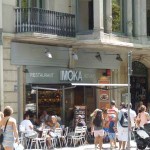
We press onward, past the fountain where everyone descends after a Barcelona soccer team game (No, we tell the kids, you cannot drink the water), and stand just opposite Café Moka, where Civil Guards were holed up inside. Across the way was the Poliorama, where the P.O.U.M. (the party Orwell fought with and more or less came to support) patrolled on the roof domes.

“I used to sit on the roof marveling at the folly of it all,” Orwell writes. “From the little windows in the observatory you could see for miles around—vista after vista of tall slender buildings, glass domes and fantastic curly roofs with brilliant green and copper tiles; over to eastward the glittering pale blue sea—the first glimpse of the sea that I had had since coming to Spain. And the whole huge town of a million people was locked in a sort of violent inertia, a nightmare of noise without movement.”

The Eyes of The World: Work-in-Progress

Ongoing updates about our work-in-progress, “The Eyes of the World: A Story of a Man, a Woman, & a Camera”, to be published by Henry Holt for Younger Readers in 2014:

Last summer, while sitting at lunch at the Vermont MFA program, chatting with many veteran children’s book authors such as Walter Dean Myers, Leda Schubert, I was suddenly thunderstruck with inspiration: I knew what my next young adult nonfiction book would be–the story of photographer Robert Capa, the less-known Gerda Taro, and their friend Chim, as they set off to photograph the Spanish Civil War and create modern photojournalism–and war journalism–as we know it today.  Nothing like the company of other authors, bubbling with their own ideas, to set one going.

Indeed, given that this is very much a story of a man and a woman collaborating–as equals, as compadres, as artists–it seemed the perfect next book for Marc and I to write.  We had been casting about for a new idea and had touched on the idea of collaboration–various duets in history that have joined forces to create something they could not do on their own.

The story of Capa and Taro had caught my eye a few years ago when I went to an exhibition at the International Center for Photography–“This is War!”–a huge retrospective of Capa’s work.  I’d always been fascinated with the Magnum photographers, and fell in love with those images from the Spanish Civil War–the molded, strong faces staring up at a sky strafed with war planes; children playing see saw amidst rubbled buildings.  At that exhibition, I became acquainted with Taro’s work, which also shared a smaller exhibition space.  I learned that in fact she and Capa were an artistic team–Capa & Taro–and they had gone off together, as lovers, as friends, as co-conspirators in the aim of telling the world about the Republican cause.  Like so many of their generation, they believed that the Spanish Civil War was the war to stake a claim–that if it was not won–Europe would surely fall to fascism.  (And of course they were right in this regard)  Armed with their new, lightweight Leicas and Rolloflexes, they set off, arriving in Barcelona on August 5th, 1936.  Sadly, Taro would not live more than a year, as she was killed during the Battle of Brunete in July, 1937.  This is one of the reasons her work is not as well known–she died very young, just as she was emerging as a daring and canny photojournalist in her own right. Continue reading

Kolkata Return: The Heritage Site

Still jet-lagged and bleary from an over-three week trip to India, I did want to make mention of the inauguration of the heritage site at the Kidderpore Docks in Kolkata, honoring the over 1.5 million indentured workers who left India in the 19th and early 20th century.  This was the same place that a number of us visited 3 years ago, and since then, the project has blossomed into a full-fledged site and potential museum.  While I was unable to attend the actual ceremony, thanks to Gautam Chakraborty of the Kolkata Port Trust, I did take a small boat with my husband and boys, up the Hooghly.  We sat huddled under shawls, sipping cha, squinting out at the diminishing gray winter light, trying to imagine the monumental journey these emigrants took.  Not sure if my sons, in between squabbling, quite understood the import of our little voyage, but it was a start. Continue reading

Welcome to Crossing Over, the blog of author Marina Budhos.

Parkway PlanI grew up in Queens, NY, in Parkway Village, a community built for U.N. families, and a haven for international, mixed, and American families during the ferment  of civil rights and social change.  Over the years I’ve come to understand that this sense of crossing over, of mixture, permeates my way of seeing the world.  And it drives my writing too.  I am an adult author who crossed over into young adult; a  fiction writer who frequently crosses over into nonfiction; and a writer who loves to create worlds that capture these cultural complexities.

But I’m also leery of categories that can be too confining.  To me, that’s the very spirit of crossing over–resisting easy labels.  So, in its broadest sense, Crossing Over aims to capture what all writers do: we cross over into territory both familiar and unknown.


© 2026 Crossing Over

Theme by Anders NorenUp ↑