One evening, in the midst of Dubai’s staggering skyscrapers, my husband and co-author Marc and I set off in search of a meal. We were there for the week, presenting at the American School, with plans to later travel to Oman for our spice research. The heat was strong all day, smacking us like a damp towel as we stepped out of the air-conditioned hotel each morning, but as evening arrived, the temperatures cooled and became more comfortable.
Despite its cold towers of glass and steel, the neighborhood we were staying in had a strangely homey feel. Across the way lay a gravel park with shade trees, a promenade, restaurants, grocery stores, pharmacies, barbers. On the balconies of buildings, one could see clothes drying on racks, crates of children’s toys. Filipina women in tee shirts and leggings bought their groceries. Indian women pressed their mobiles to their ears, talking in rapid fire Malayalam. A sturdy toddler ran and scrambled up a set of low steps, followed by his father, in a cut off tank top and gym shorts, calling out in Russian.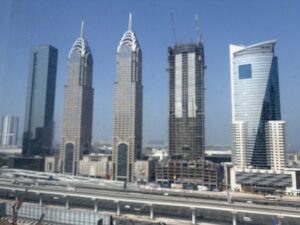
The area reminded me of the residential neighborhood in Madrid alongside the Manzanares River, where we had stayed twice last year, with its blocks of middle class brick apartments. There too came a leisurely spill into the plazas and streets as the day wound down. In hot countries, real life emerges at dark and can wind on for hours and hours, the sound of a soccer ball being smacked, children calling to each other long past the time when most American children would be in bed. Everyone lingers on benches or a late meal; everyone needs the hours to stretch on just a little bit longer.
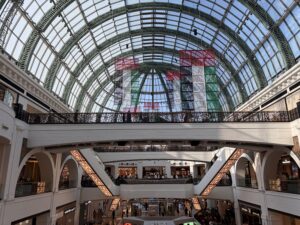 What surprised me about Dubai was how sprawling the city, how difficult it was to actually reach its fabled beach fronts—I longed to do a swim in the warm Arabian Sea—but the city is a looping maze of poured concrete highways and ramps and there was no straightforward walking there. We were often tired after long days presenting. One visit to a mall was enough for me and I had no desire to try another one next to the water. And so it was that as the skyscraper canyons cooled, we spent more times in this neighborhood, braving the traffic (which always stopped politely), and absorbing its local rhythms. We watched basketball and volleyball games being played right opposite a mosque. Once my husband needed a haircut and he stepped into one of the many, many men’s salons, sitting in a cubicle made private by a cloth curtain, to receive one of the best haircuts he’s ever had. A group of South Indians, who had just celebrated Navatri, were heading home in their crackling colorful clothes.
I have always been drawn to Salman’s Rushdie’s vision of the mongrel. I am a mongrel—half Indo-Guyanese, half-Jewish, family scattered all over the globe. Mixture, mingling, no one settled identity or perspective, has always governed my sense of self.
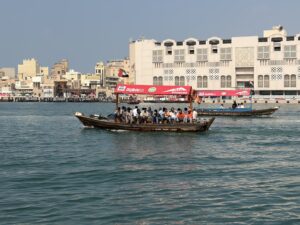 Dubai, which has built its wealth on trade and finance (and exploitation), is the essence of the shiny new mongrel. There is a live and let live feeling here, within certain boundaries. This is a controlled and watched society. When we arrived at passport control, they handed us free SIM cards, which we chose not to use, for fear of surveillance. But in the social contract of a place built from guests and migration (93 percent of the city is from elsewhere, two thirds of them men) it is astonishingly safe–you can leave your laptop in a mall, we were told, and find it later. Dubai has turned the provisional into a settled ethos of place. Come and make money, or come and park your money (however ill- gotten for much of it is indeed shady) and you can be a part of Dubai.
The spice trade, historically, also created such cosmopolitan havens. In Alexandria, Venetian merchants would arrive and stay in the strictly regulated fondaqs—walled compounds– for weeks on end as they haggled and worked with a trade regulated by the Egyptian Mamluk kingdom. In Calicut, India, the ruler there created four separate receiving rooms, one each for Muslims, Christians, Hindus, and Jews so all would have their own place to buy and to sell. Malacca, a port city in what is now Malaysia, became a bustling multi-ethnic city, its shores lined with warehouses storing sacks of spices, and regulated by a complex system of harbor masters, rules and taxation. As one scholar puts it: “Arabs prayed with Chinese. Armenians traded with Javanese. Indians and Japanese saw each other in the street.”
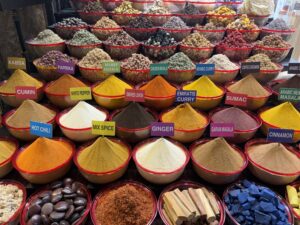
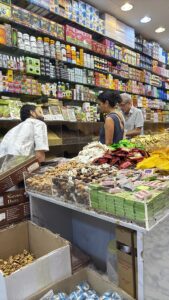 And so it was, in Dubai, this contemporary haven of mixedness, we set out to find a place to eat. I was fighting a small cold so we stepped into a pharmacy, where the pharmacist grew very excited by my Indian background, how we had visited Jaipur in Rajasthan, where he is from. Much of Dubai is Indian, and that it was my great-grandfather more than a century before, mattered not at all. Kahane? (Where are you from?) the spice merchant would ask me days later—distant origin and the present collapsed in a single instant. We were all diaspora, mingling, carried by sea or plane. The long, long history of Indian traders in the Middle East and onward to the shocking, explosive growth of Dubai means everyone carries a sense of ease at emigration, being here and there.
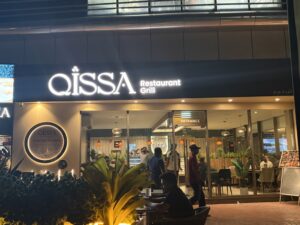
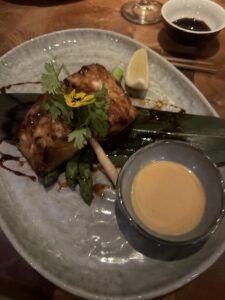 That evening, we finally settled on what looked like a popular restaurant, located just below a gym: Qissa. I ordered a simple Arabic grilled chicken that was extraordinarily moist and flavorful, scooping it up with fluffy paratha. Marc had mango shrimp curry, its sauce tinged with coconut, and declared to the waiter that it was one of the best curries he had ever—and we eat a lot of Indian food, in many places. Soon the chef came out to speak with us; he was so pleased, speaking eloquently of the balance of sour and sweet from his native Kerala.
Qissa, I learned, is fable, or tale, recounted. But its roots are in ‘piecing together.’ Writing about the spice trade is many things, but most of all, it is an act of piecing together of worlds that have often been split apart, by history and political upheavals. With exchange, however fleeting, comes contact with the unknown, the stranger.
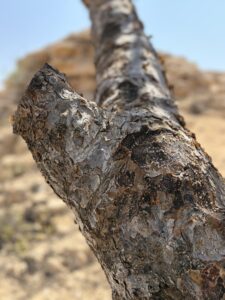
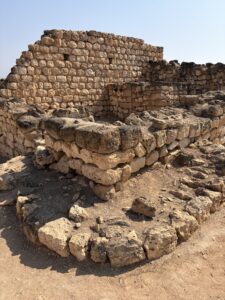
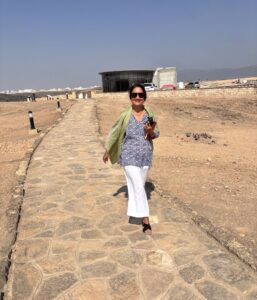
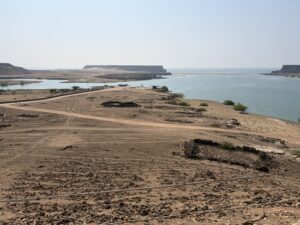
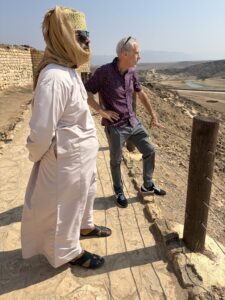
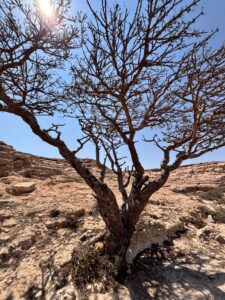
Days later, in Oman, we visited the ancient ruins where Frankincense was traded. Oman’s lush, monsoon coast meets the desert, creating an environmental band that is the perfect growing environment for the scraggly boswalla tree, from which Frankincense is harvested. Standing before this reconstructed site, we tried to understand how the Arabian groups here could communicate with the Indian traders who would dock in this hazy dazzling harbor, climb up the incline into the protected, zig-zagging entrance. What words did they use? How did they come up with a common currency and computation? Re-linking these worlds of trade is an act of storytelling, of re-connecting worlds too often rent by political upheavals and borders; too often made invisible in the polarizing here and now.
Qissa. My new, favorite word.